
Who's on first?
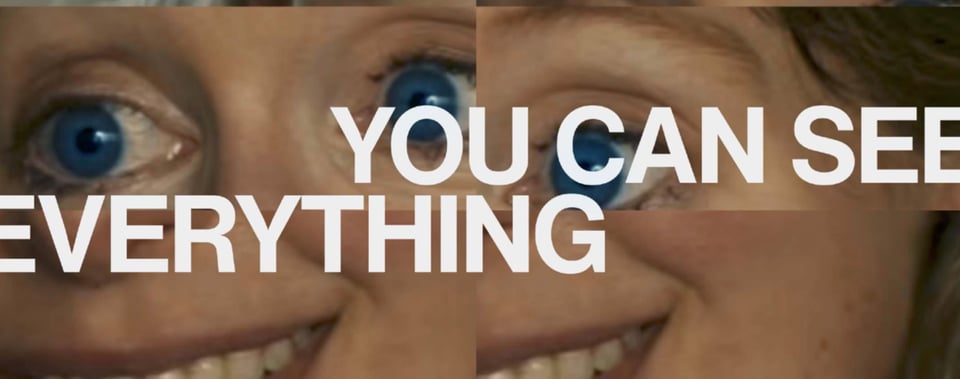
Two things are true:
1) You Can See Everything is a consistently shocking piece of documentary filmmaking.
2) If you asked had me to really imagine what a documentary about disgraced Theranos founder/CEO Elizabeth Holmes co-directed by/co-uh-starring(?) Nathan Fielder would look like… I probably would have gotten pretty close.
Those things are true in large part because I never actually considered that You Can See Everything, co-directed with Primetime director Lance Oppenheim (what a calendar month he’s having!!), could actually be a Nathan Fielder project in the way we have come to understand them.
Because, among many other reasons, his projects don’t tend to make their subjects look particularly good.
We were all, Fielder very much included, baffled to hear that he had been invited to spend the last month of Holmes’ life before she entered federal prison there with her, bringing along small-but-very-present crew.
I kinda thought that he would just be bringing his weird energy to the proceedings but that its contents would be fairly standard fare. Even after every person I’ve ever interacted with on the internet five-starred the damn thing and was like “lolwtf,” I assumed they were referring to some specific revelation about her character as opposed to something else entirely.
But as we sped through those 34 days, I kept checking my watch and becoming increasingly confused. Not even halfway through this nearly-three-hour epic, Elizabeth Holmes walks into prison. The main subject of the film will never be onscreen again.
The document has ended… and so it’s time for the art to begin.
Which is to say, it was time for a spin-off of Fielder’s hit HBO series The Rehearsal… starring Amanda Seyfried, the one from that very good Hulu show about Elizabeth Holmes, reprising said role as Elizabeth Holmes.
The smash cut introduction to Fielder and Seyfried sitting on a couch, watching the movie that we had just watched, is an all-timer, right up there with Barbarian in contention for “Best edit of the decade.”
Like so much of this film, it feels simultaneously impossible and inevitable. Impossible cuz “Nah that’s crazy” but also… we watched him make Elizabeth Holmes watch The Dropout; of course he’s going to make Amanda Seyfried watch him make Elizabeth Holmes watch The Dropout. (If this was an episode of The Rehearsal, who knows how many more levels of this we would have gone!)
It's weird to call the first half — the actual-Elizabeth-Holmes portion of the film — “straightforward,” but by comparison I think that's true. We understand what it is, even if no one seems totally clear as to why. In theory, the whole point of the project is right there in the title: Holmes and her partner Billy Evans want to show the camera crew everything because she/they (claim to) believe that she has nothing to hide and so even if there is a documentarian there literally 24/7 it‘s totally fine because everything that happens in her life is above board.
So there’s no artifice at all… except there there is. Fielder said during a discussion after the film’s premiere at the New York Film Festival that he and Oppenheim knew they had something when they would start immediately arguing about the truth of a moment they had both just witnessed… and he continues to argue with people all this time later.
I’ll admit to being above-average trusting in ways that have not always worked out for me… but I still came out the other side more-or-less believing the Elizabeth Holmes we see here. Yes, she is a convicted fraudster — a liar, but this film makes a case that is frankly much stranger, that she genuinely doesn’t understand human interaction and communication… and all the lies were genuine, baffling-to-her misunderstandings.
Critically, she does not make that case. It’s not even clear to me that she understands why she might want to do so.
And it's entirely possible that I'm being taken in, but as truly *chefs kiss* as Fielder’s facial reactions are, the idea that she believes she has “Never lied” was actually one of the less weird things to me.
A month ago, a strange clown man performing under the name Red Bastard asked a room full of people to sit down if they’d called out pretending to be sick, and I was the only one in the room who did not. “I bet you all hate that guy right about now, huh?” He said to sit down I’d ever told someone I would never leave them even though I would, and I didn’t sit down.
It’s not that those things would be true; it’s that I wouldn’t say them because I knew they were lies… so I get Fielder's bafflement but I also totally understand what Holmes (might) mean. Of course, I’ve never been convicted of lying to people, but still!
Even the wiggle room, that sure when she was younger maybe she said she wasn't feeling up to go to a party and that's not really what she thinks they're talking about, makes sense to me. I have literally had alcohol a couple times in my life, pretty much always by accident… but is that actually an important caveat?
I actually do make the caveat because I have a problem that is different than the usual one… and I've also have never been convicted of being drunk, but still. I get it.
I think.
But I don't actually get it. Even to me, Mr Honest over here, the setup is mind-boggling: three cameras and a boom op just… there for 16 hours a day for a freaking month. The last month that this family will have together for bare minimum years and bare maximum over a decade. The level of access is bonkers: we see them literally filming Holmes’ laptop screen at first, until Evans steps in to be like “What are you doing letting them film that?!”
It’s clearly a bit much for him… which is funny considering the whole thing was his idea. Like, he was the one who reached out to A24 to see about documenting Holmes’ life.
Which is super weird! But I think it comes down to the fact that Evans is just a classic Silicon Valley narcissist, the precise type of person who makes money and then moves to Texas so he can carry a gun and avoid income tax… and convinces a woman on trial for fraud to fall in love with him, sire his children, and help him set a new company in motion that he can then lead with her name attached to it.
(The fact that he thinks her name being attached to a medical diagnostic company is a selling point should be an indictment of him, but the fact that it actually seems to be one is just so damning to the entire tech industry.)
Evans wanted A24 to do the documentary because A24 is cool and he thinks he’s cool so of course he’s gonna reach out to them. He obviously believes he’s god’s gift to mankind. He says (and I think believes) that Elizabeth Holmes will be remembered not as the Scam Lady but as The Lady Who Loved Billy Evans A Lot.
And since he is able to control Elizabeth Holmes, of course he thought he’d be able to control Nathan Fielder, who he openly acknowledges appreciating Fielder’s presence because he, like* Holmes, doesn’t think the way other people do and so won’t feel like he has to just follow the public’s narrative.
Left unsaid: “I’ll convince you to follow my narrative.”
And he tries… and fails spectacularly. As trusting as I am, that dude was lying constantly, and it was gratifying to hear Fielder regularly call him on that nonsense. “I totally didn’t know that the girl I was talking to was Elizabeth Holmes until like an hour in!” such bullshit omfg. But even the things that he says that do feel true don’t reflect particularly well on him, like the thing about Holmes building him a monument to her love.
That’s bonkers, and he sucks — but not in an especially interesting way.
Elizabeth Holmes, though? Man she’s interesting. And has permanently reshaped how I think about Abbot and Costello’s classic comedy routine “Who’s On First.” It’s truly one of the greats, and it gets a chuckle out of me every time I hear it. And it’s great because we all understand why it’s funny!
Or so I thought!
Elizabeth Holmes does not understand why it’s funny… or that Who is the one playing first base.
This moment is everything. How you understand that moment will shape how you understand everything around it. I generally assume that documentary subjects will say whatever (they think) makes them look good in the moment. If they think that’s the truth, that’s what we’ll get. If not, we get a lie (or at least misdirection). A subject may be tricked into admitting the truth when they want to lie, but a straightforward conversation captured on camera will be precisely as honest as is useful for the subject.
Elizabeth Holmes not understanding that Who is on first does not look good for her. It will not stop her from going to prison. It will not increase investors’ confidence in her. The only thing it does is make her seem like an alien. And I guess if she wants to convince me, Alec Kubas-Meyer, that she is merely delusional instead of a fraud… tbh mission accomplished.
But to what end?
I did not come out of You Can See Everything understanding what made Elizabeth Holmes a force worth documenting in the first place. The woman we see isn’t conniving or even especially smart. Instead, we see a woman completely detached from reality — at least partly by choice — who loves her family and wants to be involved in a cool product while also not seeming especially concerned with the technical aspects of that product. I guess she’s a great partner to self-aggrandizing men.
(Is that infantilizing? Kind of! She comes off like a child!)
Things don’t get any clearer in the Amanda-Seyfried-as-Elizabeth-Holmes portion of the film; if anything, it’s worse, because 1) now we’re seeing recreations of Holmes and Evans written based seemingly on memories rather than actual recordings, and 2) because we’ve seen The Rehearsal!
We have seen a show that is centered on preparing people for weird/uncomfortable situations by running them through all possible outcomes of that scenario over and over again, hiring actors and building 1:1 sets and just really committing in the most deranged way. Honestly, if Season 3 has an entire episode dedicated to Fielder and Seyfried running through all the possible conversations that the latter could have while the two of them are having dinner with Evans, I wouldn’t be totally shocked even if I would still lose my freaking mind.
Which is why I think that Amanda Seyfried’s real performance in You Can See Everything is not as “Self” but as “Amanda Seyfried.”
Whether Holmes and Evans are being “real” or not, I am confident they were speaking off the cuff (or at least with answers that they had formulated by themselves in their own rehearsals ((I don’t think narcissists do those cuz they don’t think they need to.).)
I’m also confident we’d know if they were, because they’re not Golden-Globe-awarded-and-Oscar-nominated-levels of good at convincing people they’re not reading from scripts.
Amanda Seyfried on the other hand? You absolutely cannot trust a word she says to be a word she said.
Fielder says that there was no “plan” in place here, that the entire project had a kill switch because it was not clear at first whether there was even a story worth telling. That he just kept following leads and finally found one that would be interesting… but I also think that some of the conversations between the two of them feel a little too… perfect. These professional performers interrogate each other in ways that could be natural but also feel a little narratively convenient?
It would be extremely on-brand for Fielder to have put his words in her mouth to turn the screws on himself… and also to use her as a mouthpiece for his own perspective on e.g. what truth in television is.
Like, he’s literally done that before!
But my curiousity about whether Amanda Seyfried is “Amanda Seyfried” comes more as an artist than a critic, because I don’t think the answer really changes the nature of what You Can See Everything is. Even if 100% of those conversations was scripted, so what? Every documentary is scripted. When you see Nathan Fielder for the first time standing in the room watching Holmes and Evans, that moment isn’t “real” because his presence is only a surprise to someone who wasn’t in the room.
But that doesn’t mean it’s fake, right?
…
Right?
Nine Point Five out of Ten