
What if Flock cameras were cute tho
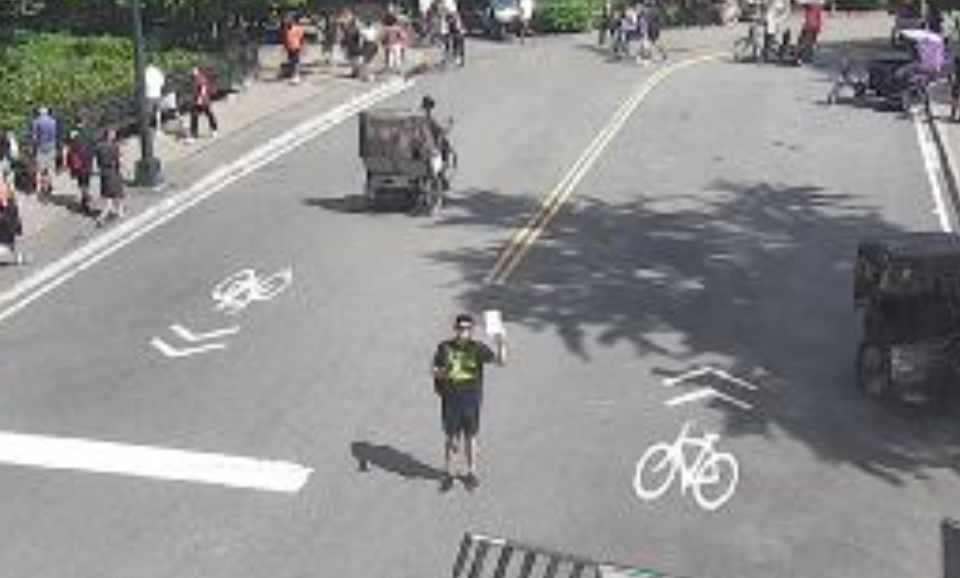
The above image was captured earlier today by a traffic camera at the West 72nd Street entrance to Central Park. There are other cameras five blocks north, six blocks south, and two avenues west. Having been a resident of the Upper West Side for quite a number of years by this point who likes to walk and Citibike around, I have passed by every single one of these cameras hundreds of times at this point.
There are other cameras I’ve passed by thousands. One can be found a block south of my office, with another two blocks north and yet another an avenue east. On foot between my apartment and office, I pass no fewer than four and by bike at least 7. And that’s just the traffic cameras. There are also at least 150 red light cameras (a limit that was quadrupled in January), 2200 speeding cameras, the congestion pricing cameras, and a whole bunch of bus/bus lane cameras too… plus the ones in subways and also the numerous privately run cameras in shops and apartment buildings: in 2020, Amnesty International volunteers were able to spot more than 25,000 street-facing cameras, and it’s only grown since.
Which is why no one was surprised that there was a near-immediate, days-long record of Luigi Mangione’s movements after he allegedly showed a healthcare CEO the same kind of care that that CEO showed his customers every day. (The Yale School of Public Health recently released a study projecting that Universal Health Coverage in the United States would save more than 100,000 people and the country $1 trillion every single year.) We know where we live: a surveillance city that is a capital of the surveillance economy under an ever-expanding surveillance state.
And while I aggressively dislike this and have done some amount of work to extricate myself from it – paying for Proton and Kagi, using Signal, etc. – I much prefer participating in society to not doing that, and I’m not about to leave New York City just to get away from cameras.
Not that that would really help! Benn Jordan’s videos about Flock Safety’s painfully-easy-to-hack surveillance systems being put up around the country and providing all manner of information to the police with basically zero oversight are probably enraging to people who aren't already living like that. But to someone who is? There’s a level of disconnection. I guess I'm like those Chinese users posting on TikTok after they left the Great Firewall who are all “I was under constant surveillance and Shanghai’s cool as hell, so what’re you complaining about?”
Especially cuz, ya know, I’ve made TikToks. And YouTube videos. And these words you’re reading right now. I could have chosen – could still choose – to be a vastly more private person than I am, but I didn’t and don’t. I have shared so much of my life with the collective you. It would hard to be argue that it wasn’t too much.
And I couldn’t stop thinking about that while reading Samanta Schweblin’s 2018 novel Little Eyes – this month’s selection for the Anthony Jeselnik Book Club and the thing I am holding up for the traffic cam. It is one that on basically every page had me thinking about Ursula K LeGuin’s classic line, “Science fiction is not predictive; it is descriptive.”
Little Eyes is set in exactly our world except for the release of a new kind of toy: the Kentuki. Kentukis cost a little under $300 and are animal-ish robots “less than a foot high” that can make move around and make noises and that’s basically it. If the battery dies, it dies forever. If its built-in cellular connection is severed for whatever reason, it dies forever. This is described as “planned obsolescence” in the book, a dig at the way so many tech companies create products meant to last just long enough for customers’ bank accounts to replenish enough that they can buy a new model. My Boox e-reader is an infuriatingly perfect example, launching with a 2-year-old version of Android that will never be updated and is already unsupported by the CloudLibrary app that so many New York Public Library e-books require… while I can still use the Kindle/Libby and bookshop.org apps, the clock is ticking.
But this isn’t really planned obsolescence in that way. The Kentuki will not get slower or less functional as time goes on. It will run as normal for as long as it runs, and it isn’t up to the manufacturer to decide when that day is. It’s for the people on either side of the robot’s cameras.
Because I skipped the most important detail: the Kentuki is not controlled by the person who bought it, the “Keeper,” but by the “Dweller,” another human who paid even more money for a tablet that links them up to a random robot anywhere in the world.
A breezy 256 pages, Little Eyes plays out as vignettes that explore different ways this dynamic could play out. And it starts with a bang, as a handful of teenage girls in South Bend, Indiana bare their breasts for their mystery Dweller and then try to get that person to blackmail one of their classmates… which immediately backfires, but before we see the fallout we’re on to Lima, Peru to follow an older woman named Emilia whose son bought her a Dweller tablet as she meets her new German Keeper.
We never return to South Bend, left to imagine the chaos that ensues, though Emilia is a recurring character, and by the end we actually see both sides of that particular relationship. Usually it’s just the Keeper’s perspectives, which I chalk up to a desire not to seat us with the dregs of humanity. It would be very easy for that scene in South Bend to play out from the reverse perspective; for us to know more about the man controlling the bot that nearly results in a father losing custody of his son. But Schweblin chooses not to, for lack of a better term, dwell on them.
Or, ahem, dwell much in general. As I said: It’s a breezy read, with most vignettes running just a few pages. You can tell that Schweblin is more of a short story writer than a novelist (I’m reading her recent collection Good and Evil and Other Stories now), but I think that really serves this particular subject. The whole thing clicked for me pretty early on, in a one-off chapter in an old folks home where a pair of Kentukis are brought in to me companions… and upon realizing where they've been placed, one Dweller disconnects and the other motors into a nearby fountain.
That was the first scenario that I wouldn't have thought of, the first sign of just how deep Schweblin was going to go. Because… yeah, absolutely. There are definitely people who would enjoy that environment, and many, many more who do everything in their power to never find themselves there. If I had paid for one of those tablets and that was my new world? Nah fuck that.
Not that I would have. The thing that one inevitably spends the entire book thinking about is whether they (I) would participate in the Kentuki economy. Which is a little weird for me because I’m not a “hypothetials” kinda guy, but I think it’s a question worth having an answer to because it does say something about how you function within this time of constant surveillance. No matter who you are, during that first chapter you’re like “Obviously not”... but as the book keeps going, in between the many horrors there are these moments of real connection and every so often I would think “Ya know what, this could actually be pretty cool” before immediately snapping myself out of that feeling.
But with the whole thing in hindsight, I’m actually torn. I know I would never have been a Dweller for kinda the same reason I don’t watch livestreamers: that kind of experience doesn’t do anything for me. The idea that you are locked to a single person creates this interesting dynamic vs a more dynamic experience like you’d get from an Omegle type thing; it isn’t “parasocial” in the way we understand that term because the person knows you exist and has a relationship with you despite not actually knowing who you are.
There’s also the fact that the Dweller cannot directly communicate with the Keeper through the Kentuki itself, though many of the pairs figure out a way around that, and some more aggressive Dwellers figure it out on their own and reach out to Keepers who absolutely do not want that kind of contact.
But even so, I wonder if I would have been a Keeper. My living with someone who wouldn’t in a bajillion years be open to having someone looking into her life (even if she found the robot cute, which I’m sure she would) and also an extremely cute and friendly cat makes the practical question even more irrelevant… but again the point of the exercise is to understand your own relationship to this kind of thing, and obviously I’m just generally okay with being seen.
I don’t want every aspect of my life on the internet, but I don’t ultimately care if every part of me is. In fact, you can see me completely naked in the film Bishop’s Cove, which is streaming on Amazon Prime; in the first few minutes, I strip at gunpoint and then get killed (brutal movie).
And of course I had an internal debate about this very question before coming to the realization that doing this would free me from a certain kind of unfounded fear. There are no compromising photos of me, but on the off chance someone hacked into my laptop’s webcam and has a clip of me showering or something… so what? I watch Good Mythical Morning while showering and I refuse to be embarrassed. In any case, people can see the same thing shot on an FX6 in glorious 4K resolution. (Plus I was in better shape then.)
But even if I’m conceptually okay with having someone watch me, I actually would be more bothered to know who it was. Some of Shweblin’s characters try harder than others to keep their distance – to treat the robot like an animal companion rather than a human… and I’d definitely be the same. Talking to people you can’t see on a livestream when you have a background up or whatever is one thing; talking you a person you can’t see who can just wheel around your home and life at will? Something else entirely.
And maybe there’s a part of me that’s just curious how long my Dweller would last. How many times would they log in to roll around and chirp/growl/whatever sound it is my robot would allow them to make before they got sick of it and of me? How many times could they hear me talk through the same anecdotes and ideas before they realized that actually their life would be better spent doing basically anything else?
…
I hope you’re enjoying my newsletter.
Eight Point Five / 10