
An Old Tale from Way Back When (That I’ll Sing Again and Again) [Issue #4]
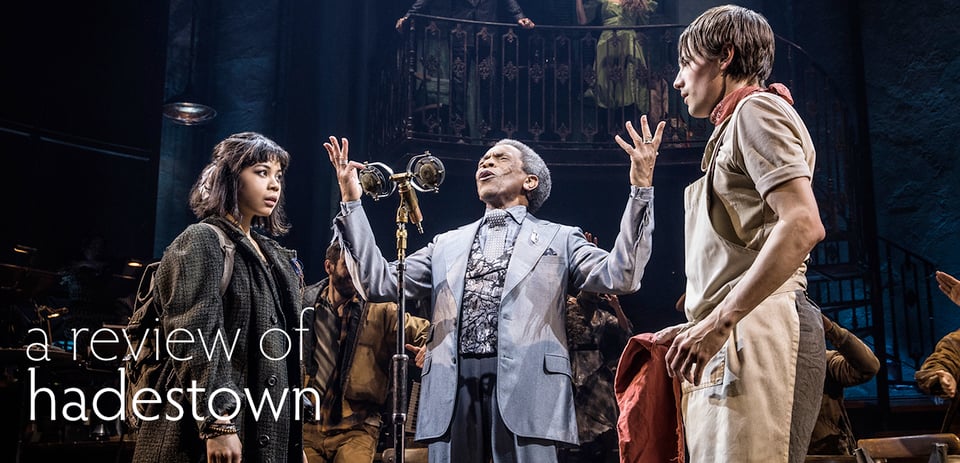
In the second meeting between Paul Mezcal’s William Shakespeare and Jessie Buckley’s Agnes Soon-To-Be-Shakespeare-I-Guess depicted in Chloe Zhao’s Hamnet, she tell this man who will become the most famous storyteller in the history of the world that if he wants her wooed, he must tell her a story – one that moves him.
He chooses the Greek myth of Orpheus and Eurydice, and he gives her the absolute barest bones version of this story… but it still moves her, because of course it does: A man travels to the underworld to save his love but in the final moments makes a choice that dooms her (and so them both) for eternity.
How could you not be moved? These myths are millennia older than Shakespeare and endure nonetheless.
I learned most of my myths reading children’s retellings, though now Supergiant Games’ acclaimed Hades – which features Orpheus as one of the characters you can befriend/help/whatever – and/or its recently released sequel – which may or may not feature Orpheus (I haven’t played it yet (despite having bought it on release (despite being halfway around the world at the time))).
But while Shakespeare’s stories endure in part because they’re so easy to adapt and there's an industry of actors who specifically train in his works… Greek myths are just stories. They don’t have dialogue or songs or stage directions. Plus, most of them are capital-p Problematic and also Big Fucking Downers, and putting all of the effort into creating those things and de-Problematizing what will still be a Big Fucking Downer is not a small risk for an artist looking to make something Big.
So Anaïs Mitchell started small. Her folk opera, briefly titled A Crack in the Wall but quickly renamed Hadestown, began life in the mid-aughts as a regional musical that then became a concept album in 2010, then an off-broadway musical in 2016, before doing some trial runs in Canada and London before finally reaching Broadway in 2019. In the years since, it’s reached 2000 performances on Broadway, expanded to the West End and more recently Amsterdam and Melbourne and of course the tours. It is a hit and one that seems to be growing every year.
Which feels both gratifying and inevitable. Gratifying because it is distinctly unlike the sort of pop-infused production that has taken over Broadway: it's a musical adaptation, I guess, but not like those of Be More Chill, Beetlejuice, Moulin Rouge, Tootsie, and fucking Percy Jackson – all of which premiered the same year (I’ve seen two of those and liked them both, but come the fuck on). It was also the first show entirely written/composed by a woman to win Best Musical. It had a depressing number of realities stacked against it.
But inevitable… because it's really fucking good.
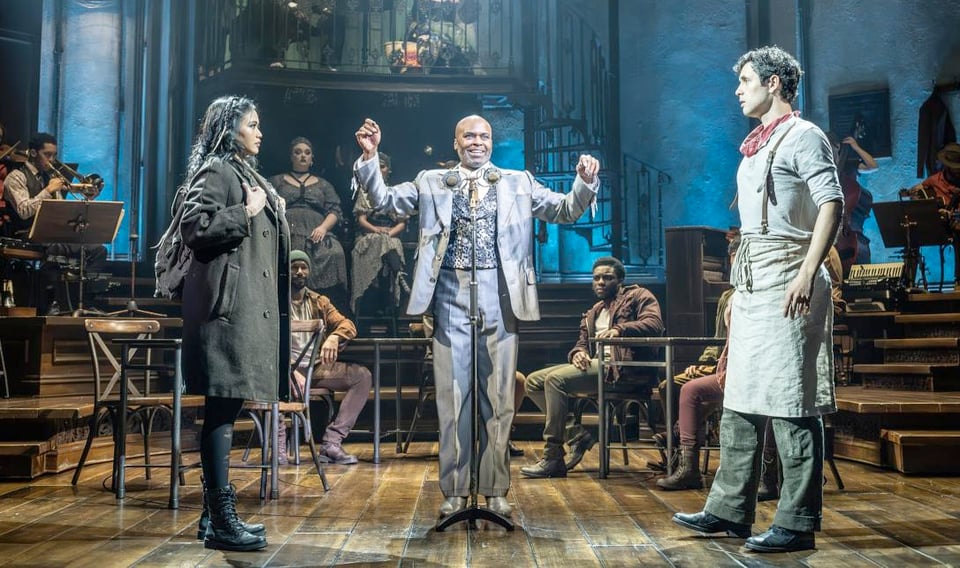
Hadestown is a mishmash of mythology, but at its core it combines two: Orpheus and Eurydice’s tragedy and Hades and Persephone’s whole thing. And it tells you right from the opening what kind of story it is. Backed by an onstage band of horns, strings, drums, and keys, Hermes – messenger of the gods and our narrator – sings:
It’s an old song
It’s an old tale from way back when
It’s a sad song
It’s a tragedy
But we’re gonna sing it anyway
So even folks who don’t know what’s going to happen know they’re in for it. (Presumably this is why Shakespeare titled his sadder shows things like The Tragedy of Hamlet, Prince of Denmark instead of just Hamlet.)
And The Tragedy of Hadestown does indeed have some real sadness in it, though it can take some time to internalize just how sad when it’s a soundtrack of absolute jams. I’m not really one for folk music – even the original concept album doesn’t appeal to me sonically – but when it all comes together beneath those lovely Off-/Broadway voices, man that shit just hits.
In a wintry world where food is scarce until Persephone brings the Spring, humans like Euridyce have to scrounge for food. When we meet her, she’s got the whole Little Matchstick Girl vibe with the fates coming to blow out her one candle to pour salt in the wounds. Sad. Pathetic, even. But she’s beautiful, so Orpheus, a gifted musician mentored by Hermes, decides that she will be his. And like most Greek myths, that means he gets her… though unlike the myth, she needs convincing. His opening line being “Come home with me” is funny every time I hear it (also basically the same shit Billy says upon meeting Agnes in Hamnet), but she’s the one who gets the good lines:
E. A singer, is that what you are?
O. I also play the lyre
E. Oh, a liar and a player too? I've met too many men like you
(Nice.)
But when she finds out that he’s been working on a song to bring back Spring – when he sings a piece of it and produces a flower out of thin air, that’s certainly something that no other man can do for her. So they wed.
Clearly, Mitchell cares a lot about giving this story’s women even the slightest bit of agency. The show’s politics feel more modern than they are: a song called “Why We Build the Wall” is not a reference to the border wall but an imagined border erected by an authoritarian strongman in a future ravaged by climate change. The reactions that many of us had in 2016 and then harder in 2024 – “Maybe this is who this country wants and who this country is” – is the one Mitchell had 12 and/or 20 years earlier, when president/war criminal (redundant, I know) George W Bush was reelected.
But while Hades is the authoritarian strongman, Mitchell wanted to humanize him at least a bit. In myth, Persephone does not come willingly to the underworld: she is kidnapped. Any love she has is Stockholm Syndrome at best. But here, it’s a more honest kind of affection, albeit one that became more honest over time. Between the concept album, Off-Broadway, and Broadway, nothing changed as dramatically as “Epic III,” the song that Orpheus wrote to bring back Spring.
Epic III It tells the story of Hades and Persephone, and the way that story is told shapes the meaning of the play, so it’s strange how different the final version is… and it’s not even really “final”! Last year, Mitchell suggested a small lyric change to that song specifically, which has since been adopted on both West End and Broadway, but I’m gonna give an ice cold take here (if Reddit is any indication) and say that the Off-Broadway version of Epic III is significantly better than the Broadway one.
These are the opening lines of the Off-Broadway version:
Heavy and hard is the heart of the king
King of iron, king of steel
The heart of the king loves everything
Like the hammer loves the nail
But the heart of a man is a simple one
Small and soft, flesh and blood
And all that it loves is a woman
A woman is all that it loves
And the equivalent on Broadway:
King of shadows, king of shades
Hades was king of the Underworld
But he fell in love with a beautiful lady
…
This moment feels like seeing the remake of a film and then going back to the original. When you don’t know, you’re like “Oh this is so nice” and etc. (though tbh “he fell in love with a beautiful lady” has always been my least favorite line in the show)... but then you see what it was and think “Ah fuck.”
Fortunately, the disappointment is isolated: most other changes are neutral at worst and often for the better. I’m certainly glad that the show got longer with each pass, because it’s a world I keep wanting to stay in – and a world I keep wanting to hold off the tragedy of.
The first time I saw it, I knew it was a tragedy (they told me as much), but I didn’t remember what the tragedy was… until I did. Eurydice’s death is another case of adding depth to a character. In myth, she is bitten by a snake while either dancing with nymphs… or running away from a creepy shepherd trying to kidnap her (fun Hinge prompt: which version of that story speaks to you?).
Mitchell’s version is way sadder. After bringing Spring, Hades forces Persephone home early, plunging the world back into the cold, at which point Orpheus begins obsessively working on his Epic to bring it back. And as he does that, Euridyce begins to starve, at which point Hades comes in to offer her food in exchange for… everything. And when Orpheus can’t or doesn’t hear her cries, she agrees.
Bleak!
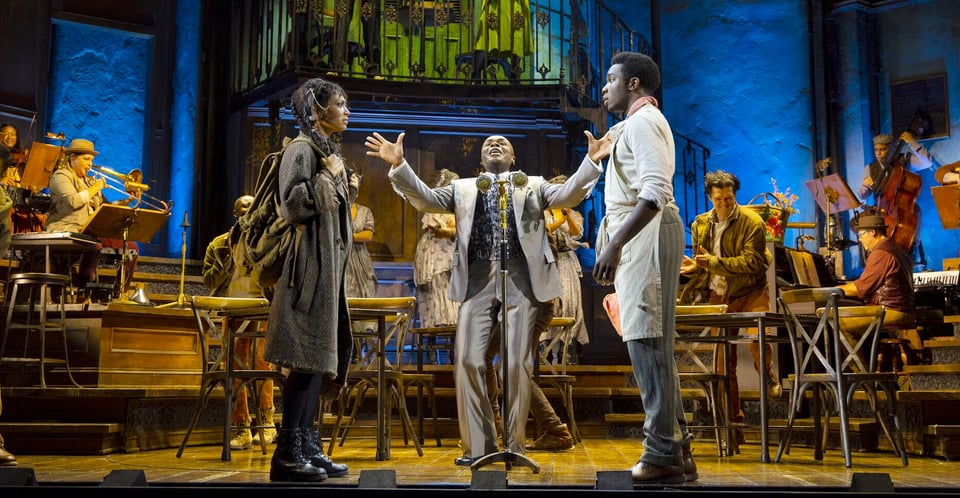
But of course that’s not the tragedy, because Orpheus goes down to Hadestown to try to get her home. And after tugging at the god of the underworld’s heartstrings, Hades gives them a test: they can walk back, but they will walk in silence with Orpheus in front. If at any point he looks back to see if she’s there, if she is there, she is doomed back for eternity.
And as he explained the rules, I realized I did know this story, and I transported back to the opening song:
See, someone's got to tell the tale
Whether or not it turns out well
Maybe it will turn out this time
And goodness gracious did I want it to turn out this time.
I’ve seen Hadestown two more times since – once a few months afterwards and then again like a week and a half ago. And each time, I appreciate what the show is doing more. It was especially fun this most recent time to see an all-new cast. While I missed Patrick Page as Hades – that part seems made for his voice – his leaving the show is the reason I got to see him perform a number of Shakespeare’s darkest monologues in his one-man-show All the Devils Are Here, which was amazing, so… worth it!
And the current Hades, Paulo Szot, is quite good… just not as good.
Yet that’s a beauty of theatre, of shows that run for years instead of weeks or months: you get the opportunity to see different takes on a character. The words don’t change, the choreography stays the same, but there’s a lot that an actor can do in the cracks between. Even on Broadway, in a theater where most people can’t see faces clearly, you can see and hear and feel the difference.
I most recently saw the show with my sister, who’d previously seen it with an underwhelming understudy, and she was dazzled by a proper performance. The current Orpheus, Jack Wolfe, is much younger than Reeve Carney, and Morgan Dudley appears younger than Eva Noblezada; this apparent youth results in something more like a proper Romeo and Juliet: these are kids. Of course a kid would tell a girl he just met that they’re gonna be married. Of course she would give in when he sings her a beautiful song.
Of course he would make the stupidest decision imaginable.
I feel bad for Wolfe, whose mousiness is exactly the sort of thing that Gen Z girlies fawn over… so he’s had to stop meeting fans after the show because the girlies have wanted him to marry them because he sang them a pretty song.
Which sucks.
But I’m fortunate to have seen his take, and I look forward to seeing more in the years to come, because Hadestown has over the past few years become my favorite musical. Les Mis matters to me as the first show I ever took part in in community theatre so many years ago, and I do still love it and will always love it… but Greek Tragedy is more interesting than French History, and Anaïs Mitchell is a more compelling lyricist than Herbert Kretzmer (who handled the English translation of the French original (she’s probably also a more compelling lyricist than Alain Boublil and Jean-Marc Natel, but I don’t know French so that seems unfair to say definitively)).
The most poignant moment for me on this particular viewing came early on. Persephone had returned and Orpheus was standing on a table giving a toast. “To the world we dream of,” he said, looking at the others on the stage. And then a pause, and the entire cast looked out at us.
“And the one we’ve got.”
…
Nine Point Zero / Ten
Filed Under: Comedy & Performance