
When Your Fun Murder Mystery Gets God In It [Issue #3]
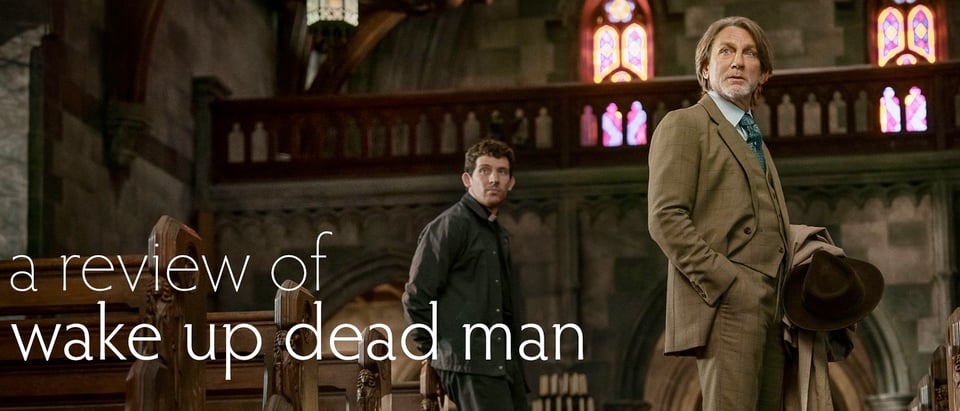
Some of my reviews assume you’ve seen the movie and talk openly about the whole dang thing. This one does not.
I don’t like how much time I spend thinking about money.
At least most of this is entirely my fault. Every day, I make an active choice to learn about Silicon Valley’s latest evils, and within seconds of looking into whatever’s going with crypto or the thing most of these companies have since pivoted to (“AI”), your brain is poisoned by the ungodly sums of money being literally lit on fire by revived coal plants. I’ve read so many of Ed Zitron’s premium newsletters breaking down the economics of data centers and GPUs and “inference” that I now think of A Billion Dollars as “not that much money, actually” until I look at my bank account and crash violently back to earth.
And by earth, I mean New York City: its financial capital (still… for now). People talk about money here all the time. Whether they have it. How much of it they have. How much their rent was last year, is this year, and will be next year. What’s their 401K. Does the company have a good match. Is it better than your match. Probably: your company’s match is literally pathetic. You’ve emailed your benefits office and told them to stop calling it a match because claiming there is one is as good as lying to prospective recruits.
(The You there is Me. I did that.)
Rian Johnson seems sick of this, too. Right from the jump, he was digging into swindlers and conmen… and he never stopped. He even threw a cynical depiction of wealth into the middle of his Star Wars movie! Which you gotta respect, even if you don’t really like that scene (which I don’t particularly, though I’ve come to appreciate its thematic purpose).
The Knives Out films are no exception. Johnson’s cinematic mystery series – distinct from his currently-canceled-by-Peacock-but-hopefully-picked-up-elsewhere mystery TV series Poker Face (which is also very good and largely about money) – sees Daniel Craig as Benoit Blanc: a modern-day Hercule Poirot with no silly moustache but an even sillier Southern Drawl. Blanc is a minor celebrity in this world, normie-famous enough to have appeared on The View, and he picks projects that seem particularly puzzling.
Given that greed is at the heart of virtually every murder mystery ever, it’s no surprise that an inheritance dispute triggers Knives Out’s mystery, nor that Glass Onion’s political satire is wrapped up in an Elon Musk analog not quite capturing how deeply stupid Elon Musk is (but coming very close!). The latest in the series, Wake Up Dead Man, also puts money at the heart of the killing but not in ways or for the reasons you expect, because Johnson is sick of money and has something else on his mind: God.
I grew up going to church, but not a God-fearing one. While Unitarianism and Universalism were both Christian, Unitarian Universalism is humanist – proof that two wrongs can make a right – and so my virulent skepticism of religion was ever-so-slightly tempered by the fact that I didn’t actively hate my own Sunday School experience. I don’t know that I liked it, particularly (except for the day where we collectively filled a white board with whatever euphemisms we knew for penises and breasts and etc.: that was a good day), but I wouldn’t say I survived it the way some people look back on their more aggressively godly Sundays.
(I should have spent more years in the Youth Group, given that the year I was with them, a guy convinced all of us to treat Devourment’s Babykiller – objectively one of the most depraved songs ever written (I cannot overstate how fucked up the lyrics are) – as a sort of anthem. Hilarious.)
Rian Johnson grew up with more aggressively godly Sundays in a very different kind of church, and the near-evangelical Protestantism stayed with him into his early 20s. At this point, nearly 30 years later, he’s spent most of his life a non-believer, but (I have been given the impression that) non-belief after a childhood like that exists as a direct response to that childhood – a permanent tension between your current and past selves, and that tension is at the core of Wake Up Dead Man.
Unlike the first two films, Benoit Blanc actually comes into this one fairly late. He is shown right at the beginning silently reading the story written by Father Jud Duplenticy (Challengers’ Josh O’Connor) that will make up much of the film’s runtime, but we won't be seeing him again until that story is well underway – almost exactly the 40-minute mark.
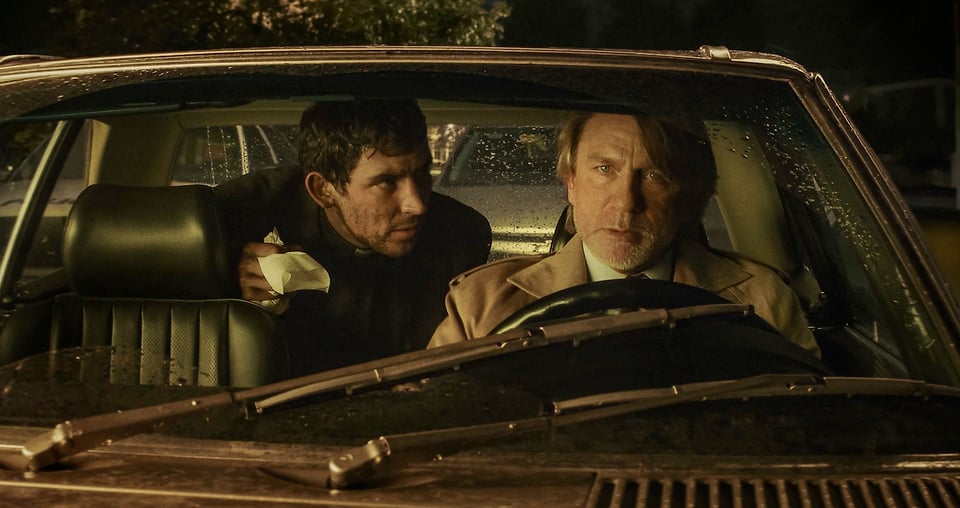
Father Jud’s story is a classic: boxer hurts someone real badly in the ring and turns to Jesus (by way of Catholicism) for salvation; frocks up to help others find that same salvation; punches a particularly unpleasant colleague (maybe the only good-bad thing a Catholic priest has ever done); and gets reassigned to an upstate parish known as Our Lady of Perpetual Fortitude, overseen by the differently unpleasant Monsignor Jefferson Wicks (Josh Brolin, capping off a very strong year). Where Father Jud is trying to put violence behind him, Wicks fixates on it: directing sermons about hellfire and divine punishment at would-be members of the congregation, dwindling down his “flock” to a kooky cast of characters perfectly sized for a proper murder mystery – convenient, given that the big man’s about to meet a seemingly impossible end.
(The repeated use of the word “flock” felt condescending – Wicks taunting his bleating sheep, but the Internet tells me it's normal church lingo which doesn't mean it's not condescending but Father Jud also says it and definitely doesn't mean it condescendingly.)
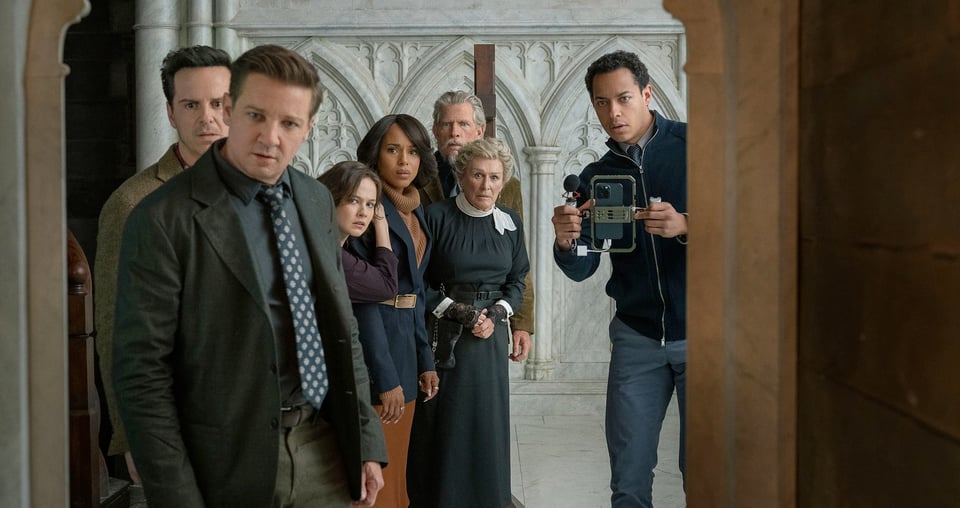
The ensemble is key to the success of these stories, and “kooky” here means “Not people I would invite to dinner parties”: there's the alcoholic doctor, jaded lawyer, radicalized novelist, right wing influencer/wannabe politician, woman suffering from chronic pain (☹️) who has decided to give infinite money to a conman (😡), and woman who has dedicated literally her entire life to that conman (and her husband).
The dynamic is closer to that of Glass Onion than the original Knives Out – a series of unrelated people brought together by their common relationship to a towering central figure, but these stereotypes/archetypes/whatever are more generally more grounded the previous outing’s (minus the influencer, who within minutes of meeting this new priest lists all the things he doesn’t believe that he tried to exploit for votes) and that common relationship comes from a very different place: as much as Silicon Valley-types want to believe they’re Gods, Edward Norton’s Miles Bron was just an idiot with influence, and that influence certainly wouldn’t pass the pearly gates of heaven. Monsignor Wicks is not an idiot, and his influence for those who believe is everlasting.
With the exception of devout caretaker Martha Delacroix (Glenn Close, who has talked openly about growing up in a cult), this group does not come off as especially “religious.” They’re like a lot of the Catholics I’ve known in New England: showing up on Sundays to make sure they get into heaven – maybe they say Grace at the dinner table… but moment to moment they’re not really thinking about Jesus all that much, and like most people with conservative politics they aren’t especially interested in many of Jesus’ teachings: When Father Jud tries to start a more wholesome kind of prayer meeting, everyone skedaddles as soon as it becomes clear that Wicks won’t be attending, because it turns out that God’s not the one they’re afraid of.
None of this is subtle, but I don’t come to Knives Out – or Rian Johnson’s work in general – for subtlety. I come for fun, and we’ve got that in spades. While the 1 PM Sunday audience for Wake Up Dead Man was a far cry from the sold-out showing of Glass Onion that in late 2022 made me feel like theaters were finally back bb, everyone still hooted and hollered together – all having a ball, glued to the edge of our seats by the increasingly bizarre goings-on and then collectively stunned by the final reveal(s).
I’ll definitely need (want) to see it again to know for sure that all of the pieces really fit together seamlessly, but it never felt loose or cheap: I kept falling for feints or trying to outwit the movie in frankly ridiculous ways (of course there's not a secret “Lazarus Door” into the concrete crime closet), but it may be a touch too convoluted? I mean, the in-universe timer supposedly ticking alongside the final unraveling just… pauses for a while because the story takes so long to complete. (Though really, they should have just changed the length of the timer (The number was made up anyway, and I’m like 95% sure they said it in VO (Weird!).).)
In any case, “fun, twisty mystery” is table stakes for a Knives Out movie. What makes Wake Up Dead Man special is the God stuff. Johnson told Newsweek that he wanted to make a movie that talks about faith rather than at it, which is why Benoit Blanc needs to play a different role here. Even though he does have his own revelations about faith, Blanc remains steadfastly irreligious, so to actually have a useful conversation, we need a character like Father Jud at the center. The battle between Monsignor Wicks’ violent nostalgia and Father Jud’s compassion is one playing out in religious institutions across the world.
Jud calls Wicks a cancer that must be cut out, and while that makes him suspect #1 when the cancer gets cut up, he’s right. There is no value in Wicks’ ideology, yet so many people are drawn to it.
Nikalie Monroe has a “social experiment” series on TikTok where she calls various houses of worship asking for help for a fictional starving child. Some jump at the opportunity to do good. Many do not. And it’s easy for someone like me to look at the latter – people like Wicks – and say it’s enough to discredit the former entirely: that a few good apples don’t really justify the suffering caused by the rest. And maybe that’s true, but it’s also super fucking irrelevant, because the churches are still here and, at scale, not going anywhere.
And even if I may roll my eyes at them, there are people who can only find solace in religion and religious figures.
The most poignant part of the entire film comes when Father Jud calls a woman trying to find a key detail that could potentially unlock the case. At first, we giggle because she’s trying to talk about all kinds of things except what he’s looking for, and though he initially tries to get her on track, he realizes that this person needs someone to talk to and be comforted by… and that he can be that person. He leaves the room, to Benoit Blanc’s shock and dismay, and spends seemingly hours listening to her: case forgotten, because this (living) person is in need. It’s heartening to see Father Jud be the kind of person you hope that every pastor is but so few are. I rooted for him not just because I wanted him to beat the rap and find the real killer but because I wanted someone like him to take over this church. To turn Our Lady of Perpetual Fortitude into the kind of place that can actually do some good and bring some positivity into the world.
And that’s a pretty impressive thing to make me – a formerly-militant-but-always atheist – want in general. But it’s especially impressive to do that as an aside to a big fun murder mystery.
Eight Point Four / 10
Filed Under: Movies & TV